Showing posts with label The Usual Suspects. Show all posts

Sunday, June 26, 2016

Weekly Weeder: Stop Crab Grass in your lawn

Baby crab grass in bare dirt

          Summer is here, and crab grass is sprouting in lawns, very thick in some.  It’s past time to mulch your lawn, but not too late to smother a lot of it.
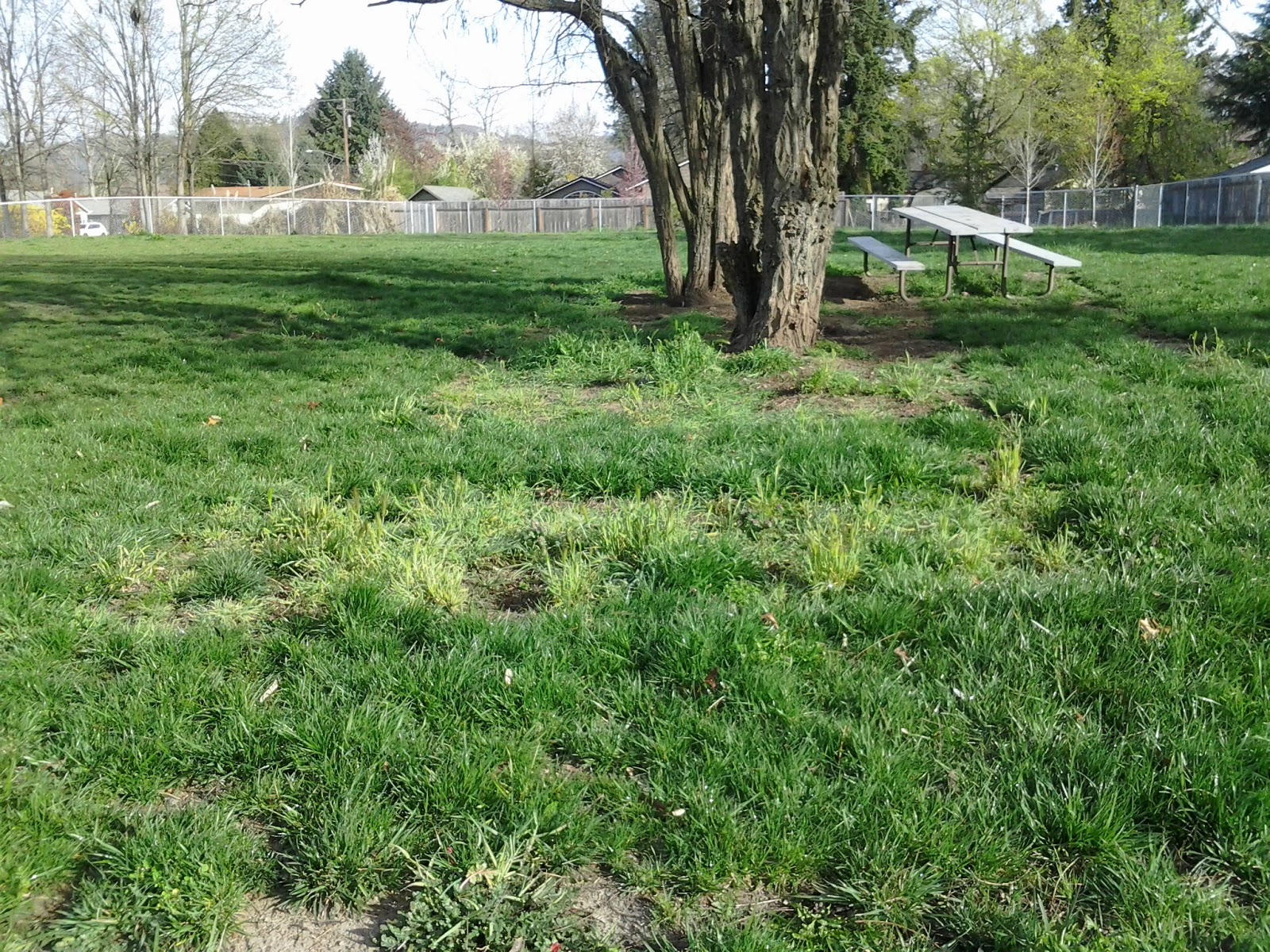
Last year, I started mulching crab grass in Dad’s lawn when it started sprouting, which was a bit late for the amount of mulch I was using, an inch of compost.  Sprouting crab grass is very small, and can be hard to see before it gets big enough to grow out of the mulch.  Not that the effort was wasted; the compost still stopped a lot of crab grass, and the lawn is looking much healthier and greener than last spring, without moss under the tree.

Young crab grass, spreading from its crown

Lawn grasses can readily grow through an inch or more of compost and will be much happier for it.  If your grass is perennial rye, a clumping grass, it’s a good time to seed more rye into the compost where it is patchy.  Mulching leaves into the lawn over the fall and winter with the lawn mower will help smother small-seeded grasses like crab grass and Bermuda.
            Crab grass is a clumping relative of Bermuda grass that also roots along its stems, but it’s tender, and dies with the first frost.  It is a tender perennial, as it does not die from making seed, but only spreads and makes more seed until it freezes.  It roots deeply where it is well watered, and hardly roots at all where it is not watered well, living on dust and dew collected on its hairy leaves. 

This young, mature crab grass appears to be growing in well-mowed Bermuda.

Bermuda grows rhizomes that can travel under sidewalks and go 18” deep and goes dormant about 6 months of the year in Oregon, making it a lawn weed in this area, not good grass.   Bermuda and crab grass show their family relationship in the shape of their seed stalks, and the size of their seed, which is, thankfully, small and easily smothered with mulch.  So the same mulching that stops crab grass can also prevent Bermuda from germinating.
Ironically, in Arizona, where they use Bermuda as lawn grass, they mulch their lawns with steer manure every spring, which keeps them thick and green in the summer heat, and crab grass is rare.  Here in southern Oregon, I don’t recall seeing anyone else using steer manure or other compost on their lawns, and crab grass has spread all over town and down our country roads in the last 20 years.  Chemical fertilizers don’t smother weed seeds, and crab grass has no problem with dryness or low fertility.

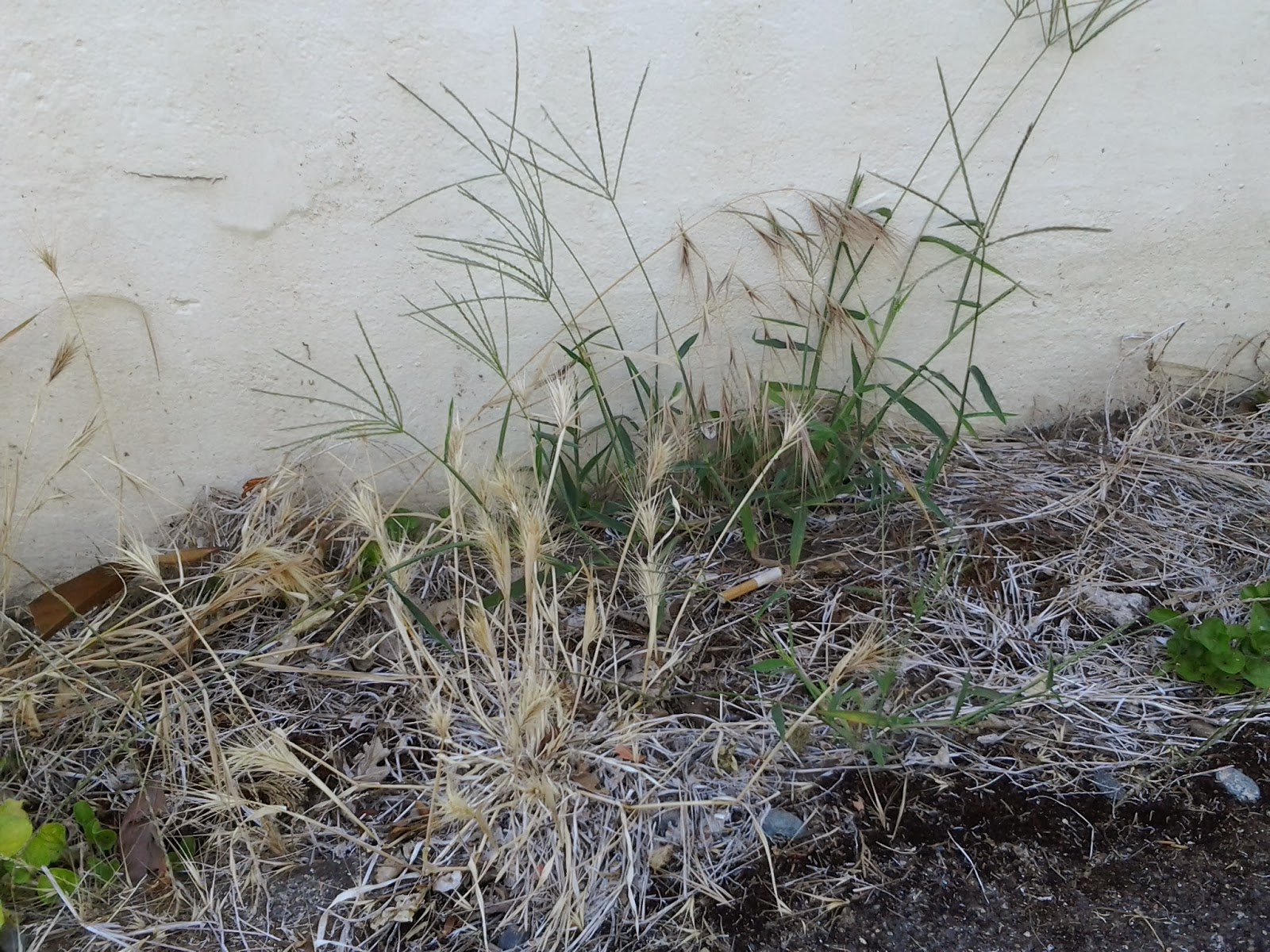
Green crab grass with dry foxtails and cheat

Even if you mulch, it is unlikely that you will stop all the crab grass in your lawn, since the seed is everywhere.  Unlike annual grasses, the roots of crab grass are tough and wiry, and where they go deep, it is nearly impossible to pull after it flowers.  But it can be cut off its roots with garden scissors or a knife, and it won’t grow back, as it has no food in those wiry roots.
It doesn't pay to spray crab grass with Roundup (glyphosate salts), even in gravel and bare dirt.  It kills the plant, but fertilizes the seed in the soil; it comes back greener every time.

Revised June 2016, online at GardenGrantsPass.blogspot.com with photos. Follow Rycke or subscribe.
Gardening is easy if you do it naturally.  Like Garden Grants Pass on Facebook.
Rycke Brown, Natural Gardener        541-955-9040      rycke@gardener.com


Tuesday, January 20, 2015

Bitter Cress and Groundsel are already seeding

Groundsel and bitter cress, blooming together

Bitter cress and groundsel are blooming and groundsel is seeding all over our valley about 2 months early, in January, indeed, before Christmas.  They usually start seeding in March.  You won’t get a better chance to eliminate them from your yard than the next few weeks—though a few plants can sprout and bloom all summer, right up to late fall. 

Young bitter cress, close up, abut 2 inches wide

While bitter cress is blooming, it is relatively easy to see by its tiny white four-petal flowers, though the smallest plants are not obvious; some are as tiny as a half-inch wide and 1.5 inches tall, fully seeded out.  The largest are 6” wide across the basal leaves with numerous stalks up to 18 inches tall seeded out.  They are easiest to pull when they have started to develop seed pods.
Just before they bloom, the larger plants are good to eat as a hot, bitter mustard green.  They are small, but softer and juicier than most mustards, good in a salad.  But don’t let them seed out; they are a nuisance.

Seeded bitter cress, popped out and ugly.

They become a nearly invisible green mist when all the flowers are finished, but as they turn yellow and dry, they become an eyesore, and pop their seeds up to three feet in all directions at the slightest disturbance of the pods.  By this time, seed control is impossible; all one can do is pull the dry stalks and resolve to do better next year. 

Groundsel, blooming and seeding in a ditch

Groundsel is also blooming right now, quickly blowing out and spreading to your neighbors’ yards or from themIt is a miniature wild lettuce and not pretty, up to a foot tall, with squared-off leaves; the flowers are yellow, do not open fully, bending over while they are in bloom, straightening as they make seed.  It is the first blowing weed of the season, blooming in yards and empty lots all over town.  It’s often easy to pull, but like other wild lettuce, sticks hard in hard ground.  Cutting it under its crown, in the soil beneath where the leaves grow, will kill it.
Dandelions are also blooming and seeding about 2 months early.  A famous gardener once said that if dandelions were rare and hard to grow, they would be a prized flower.  Their dead-heads don’t even look bad, and they can be tasty greens before they bloom—but once buds even start to form in the base, they turn quite bitter. 
Dandelions are equally hard to pull before and after blooming:  not easy at all unless your soil is loose from generous mulching with compost or leaves.  With big perennial tap roots like these, it’s best to stick a shovel in next to the root, loosen, and pull. 
Gardening is growing plants where you want them to grow, not where they happen to land.  Many a pretty flower or edible plant shows itself to be a weed unless kept under tight control, and that goes double for flowers that cast their seeds to the wind.

Revised Jan-Feb 2015 issue, online at GardenGrantsPass.blogspot.com and at the Mail Center, 305 NE 6th
Gardening is easy if you do it naturally.  Litter is tagging, marking the territory of the disorderly.

Rycke Brown, Natural Gardener          541-955-9040        rycke@gardener.com

Wednesday, October 1, 2014

Use leaves to stop weeds

Oak leaves covered with pine needles to keep them in place

Leaves are starting to fall, and they are way too useful to just rake up and put on the curb for pickup.  It’s also a lot of work to rake them out of your shrubbery and flower beds.  Leaves are natural mulch that feed soil and stop weeds, and the thicker they lie, the better they do it.  A foot of mixed leaves can grow great vegetables. They belong on bare soil and mulched beds. 

Leaves laid thick for growing vegetables

Leaves need to be removed from buildings, pavements and paths.   They should not lie too thick on lawns, where they can smother grass, but even there, they can suppress crab grass and other small seeds, while stronger perennial grasses like fine and tall fescues, can grow right through several inches as the soil warms in the spring; they are encouraged by the fertility.  Larger annual grasses, like cheat and fox tails, need a good two inches to stop them.
Most small seeds need a touch of sunlight to allow them to germinate, lest they sprout too deep and are unable to grow out from under their cover.  The larger the seed, the more food it has to grow through soil or leaf cover.  But the smaller the seeds, the more there are to sprout.  Once larger seeds have sprouted, it can be easier to smother them with mulch, if they are covered before they put a lot of food in their roots.
Naturally fallen Red Maple leaves stopping bitter cress and annual rye

Leaves vary in their ability to stop weeds from sprouting.  Very soft light leaves, like box elder, can be eaten by worms, pill bugs, earwigs, and other detritus eaters before fall is even over, and are good for feeding soil, but are fairly useless for stopping weeds in the spring.  Not-so-soft leaves, like red maple, will make it through the winter and stop early spring weeds like groundsel and bitter cress.  Tougher leaves, like oak, sweet gum, and magnolia, stick around all summer, and prevent the germination of later-flying wild lettuce and dandelions and tracked-in crab grass.
Non-broadleaf evergreens also vary in their ability to stop weeds.  Pine needles and needle-type true cedars are tough and take a long time to decompose, but their shape allows seeds to grow through unless they are over an inch thick.  Flatter evergreens, like fir and local cedars, decompose more quickly, but seem to stop weeds fairly well anyways.
One kind of soft leaf can stop weed seeds smaller than a maple nut all summer, even after they are gone: black walnut.  They have juglone, a natural pre-emergent herbicide.  They are not a problem for established perennials, but they stop smaller seeds even after the soil is bare.  Spread under a tree where birds perch, they can stop blackberries and other berry seeds from sprouting where they are laid at least an inch deep.
Use leaves; don’t lose them.  They can save you a lot of work.

October issue, online at GardenGrantsPass.blogspot.com, sold at the Mail Center, 305 NE 6th St. 
Gardening is easy if you do it naturally.  Litter is tagging, marking the territory of the disorderly.


Rycke Brown, Natural Gardener                 541-955-9040                 rycke@gardener.com

Tuesday, June 10, 2014

Kill crab grass, goat heads, and star thistle

Crab grass didn’t used to grow in Grants Pass when I lived here in the 80’s.  Neither did goat head, known locally as puncture vine for what it does to bike tires.  Star thistle was out in the country on neglected farms.  Now we have all three all over town, the last two mostly on business, government, and vacant lots; people mostly don’t tolerate them around residences.


          All three can be hard to pull, but are easy to kill with a good pair of gardening scissors.  Kengyu pruning scissors are the best.  They are super-hard Japanese steel.  They can cut through dirt and gravel and still cut branches; they slowly wear down, but they don’t knick.  They may lie outside and get surface rust, but it wears right off with use.  They can not only cut weeds out of gravel; they can cut weed crowns out of cracks in pavement.  They can be found online.
          Any annual weed can be killed by cutting it off under the crown when it is blooming.  You don’t have to get the root; it has no food in it at that point.  Once it flowers, it has put all of its energy into its crown and above.

Green crab grass with dry foxtails and cheat

Young crab grass, spreading variety.  Some stand tall.

          Crab grass (Digitaria) likes water, but it can live on dust and dew.  It is related to Bermuda grass (Cynodon dactylon), with the same fingered seed head, but no underground rhizomes.  Where it has not been watered well, it has just enough root to hold it in the ground and pulls easily.  Where it has had good water, it roots deep and hard, and roots along stem nodes as well, the opposite of most annual grasses, but crab grass acts more like a tender perennial, and doesn’t die until frost.  Its roots are thin, tough and wiry, and don’t pull when mature and rooted deep.  Cut them off though, and the plant is gone; they have no food storage.


Goathead leaves and bloom 

Goat heads in bloom

          Goat head, Terrestris tribulus, literally “ground trouble,” crawls along the ground in a spreading mat with inch-long divided leaves and ¼” five-petal yellow flowers that open with full sunlight.  It laughs at mowers, spreading its tack-shaped seeds on their tires.  Also called tack vine, puncture vine, caltrops, and other names not suitable for print, its seeds can puncture bike, wheelbarrow, and some trailer tires.   It grows well in wet or dry ground, in bare soil or thick grass, spreading up to 3 feet across.  But its crown can be cut off its root, and the root will die.


            Yellow star thistle, Centaurea solstitialis, can be seen taking over vacant lots around the newer parts of town, its bluish foliage standing out among the drying grasses.  Its spines are only on its flower buds and fold down when they go to seed, but they are enough to declare it a noxious weed.  It doesn’t spread its seed on the breeze like other thistles, but on animals, lawn mowers and landscape maintenance workers; they cling to the plant all through the winter, long after the spines are gone.  It loves dry ground, but contrary to rumor, it can take heavy watering and come up through considerable mulch.  Mowing just makes it eventually seed out beneath the blades.  But its crown is often several inches above the soil bent sideways, handy for cutting off its root.

Wednesday, March 19, 2014

Foxtails are already blooming

       Blooming foxtails in Greenwood Dog Park, suffering from a fungus that yellows its leaves

        This morning I stopped with my dog at Greenwood Dog Park to throw some balls, and noticed that foxtails were already putting up seed stalks under the locust trees, shocking in early March.  It’s more normal to see them starting to bloom in April.  I pulled a plant with a seed stalk; it pulled easily.  It’s officially weeding time at the dog park, though I expected to go after heron’s bill there before foxtails. 
Heron’s bill is just starting to bloom.  It’s normally among the earliest of annual weed flowers, but bitter cress is in full bloom and groundsel is already going to seed along the trail.  It’s going to be a heck of a weeding season, with the warm weather bringing out some weed flowers early, while others that are daylight-dependent bloom on their regular schedule.

Light colored foxtails show up well against dark green lawn grass

Blooming is the signal for weeding because that is the easiest time to kill any annual plant.  It is also the express trigger for enforcement of our weed nuisance code, which forbids allowing weeds to “mature or go to seed.”  Maturity is blooming; seeding is the next step. 
Stop the plant when it blooms, and it cannot spread seed to your neighbors, becoming a nuisance first simply by spreading.  Weeds are also ugly when gone to seed; “seedy” is a synonym for neglected.  The seeds of heron’s bill, foxtails, and cheat grass stick in clothing and fur and can downright dangerous to pets; heron’s bill drills itself in when the dry seed gets wet, and all three are barbed.  Last, but not at all least, tall, bushy annual weeds dry out and can burn.
Annual plants are easiest to kill when blooming because they put all their energy and much of the mass of their roots into top growth to produce stalks, flowers and seed, while their roots shrink and loosen in the soil. The stalks are tough and have a good hold on the crown, where all the new growth comes from.  The roots pull easily from moist soil compared to earlier in the season, when the roots are large and the top is soft. 

Seeded foxtails in Bermuda grass, showing why it pays to pull it green.

But you don’t have to pull the roots of blooming annual weeds, as there is no food in the roots.  The crown, where the growth comes from, is the key.  Cut them under the crown with scissors, and they are gone, even big tap-rooted annuals like thistles.
Preventing weeds is better than weeding.  It takes work, but it isn’t stoop work, the hardest kind of work to do.  You can mulch bare soil with leaves, compost, wood chips, or coarse bark to stop smaller seeds from sprouting and growing.  An inch of compost just before crab grass sprouts can stop crab grass and feed good grass in a lawn.   It’s time; it’s been warm and grass is growing.
For rough areas, leaves are cheapest, most effective, and encourage perennial grasses, which are good for holding ground and not becoming a huge fire hazard.  I used to dislike perennial grass, but it’s much better than annual grasses like foxtails and cheat.

Tuesday, March 11, 2014

Stop crab grass before it starts

          Spring has sprung with a vengeance.  Foxtails are already putting up seeds stalks.  Sprouting crab grass cannot be far behind.  It’s time to mulch your lawn.

 Sprouting crab grass in bare soil.  The leaves are not only fat, but fuzzy.

          Last year, I started mulching crab grass in Dad’s lawn when it started sprouting, which was a bit late for the amount of mulch I was using, an inch of compost.  Sprouting crab grass is very small, and can be hard to see before it gets big enough to grow out of the mulch.  Not that the effort was wasted; the compost still stopped a lot of crab grass, and the lawn is looking much healthier and greener than last spring, without moss under the tree.

The fuzziness of young crab grass leaves shows better in this young plant.

          Even though it is early March, lawns are growing and being mowed.  Lawn grasses can readily grow through an inch of compost and will be much happier for it.  If your grass is perennial rye, a clumping grass, it’s a good time to seed it into the compost where it is patchy.  Dad’s lawn is mainly fine fescue, a rhizomatous grass, and white Dutch clover, both of which fill in when given sufficient organic matter, nutrients and neutral soil.  I also spread blood meal and ashes, bringing up the nitrogen, iron, and Ph to help kill the moss and feed the grass.

This young mature crab grass is growing in what looks like well-mowed Bermuda grass before its bloom.

          Crab grass is a clumping relative of Bermuda grass that also roots along its stems, but it’s tender, and dies with the first frost.  It is a tender perennial, as it does not die from making seed, but only spreads and makes more seed until it freezes.  It roots deeply where it is well watered, and hardly roots at all where it is not watered well, living on dust and dew collected on its hairy leaves. 
Bermuda grows rhizomes that can travel under sidewalks and go 18” deep and goes dormant about 6 months of the year in Oregon, making it a lawn weed, not good grass.   Bermuda and crab grass show their family relationship in the shape of their seed stalks, and the size of their seed, which is, thankfully, small and easily smothered with mulch.  So the same mulching that stops crab grass can also prevent Bermuda from germinating.
Ironically, in Arizona, where they use Bermuda as lawn grass, they mulch their lawns with steer manure every spring, which keeps them thick and green in the summer heat, and crab grass is rare.  Here in southern Oregon, I don’t recall seeing anyone else using steer manure or other compost on their lawns, and crab grass has spread all over town and down our country roads in the last 20 years.  Chemical fertilizers don’t smother weed seeds.


Green, mature crab grass with dry, seeded foxtails and cheat in dry ground.  Crab grass, being a perennial, is not a fire hazard like the other two as it stays green and growing until frost.

Even if you mulch, it is unlikely that you will stop all the crab grass in your lawn, since the seed is everywhere.  Unlike annual grasses, the roots of crab grass are tough and wiry, and where they go deep, it is nearly impossible to pull after it flowers.  But it can be cut off its roots with Kengyu garden scissors, and it won’t grow back, as it has no food in those wiry roots.
It doesn't pay to spray crab grass with Roundup (glyphosate salts).  It kills the plant, but fertilizes the seed in the soil; it comes back greener every time until you spray so much, so frequently that you over-fertilize.

Wednesday, September 18, 2013

How to Get Rid of Bermuda Grass


Bermuda grass is one of the most feared perennial weeds around, even in the areas where it is considered a good lawn grass.  It greens up easily in summer with good watering, but it goes dormant for the colder half of the year in our climate, so in this area it is a weed.  It can travel up to 18 inches deep and easily travel under 6 feet of sidewalk to come up on the other side. 
 

Bermuda grass, traveling over 4 x 8 sand.
But its large, strong rhizomes (traveling storage roots) are also its greatest weakness.  They are fat and shiny, 1/8 to ¼ inch thick, easy to see and sort out from loosened soil.  Their feeder roots are thin and wiry, with no food storage.  
Dug Bermuda, showing its shiny rhizomes.


Like crabgrass, its annual, or considering it lives until frost, tender perennial, relative, they don’t re-grow from feeder roots.  We know they are related because they have the same seed stalk, with four arms and small seeds. Crabgrass grows in a clump; Bermuda grows out of the ground. Cut a crabgrass crown off its roots and it is gone; get all of the shiny Bermuda grass rhizomes out of the soil and it also is gone.  That is except for their seeds, which are small and easy to smother with mulch.
Bermuda grass with seed stalks

Mature crab grass; note the clumping growth and fat leaves.


While those rhizomes can travel deep, they don’t go any deeper than they need to travel, which is generally within a few inches of the surface. 

They can be dug and sorted out of the soil.  Push a shovel in the ground, and loosen the soil.  Pull on the grass stems.  Shake the soil off the roots, and put them in a bucket.  Get all the rhizomes out of that shovel-full; move the shovel back a few inches; loosen the soil; pull the roots.  Keep going until you get all of it.

It isn’t as easy as spraying Roundup (glyphosate salts).  But killing those fat roots with glyphosate takes all summer, and you will still have to dig the stubborn bits that insist on growing back.  They are too small to suck up enough glyphosate to kill the remainder, and those pieces may be resistant to glyphosate. 

But after killing a lawn with glyphosate, you will have thereby fertilized the ground for broadleaf plants and annual grass, not perennial grass, and lawn grass won’t grow well.  This is okay if you would rather weed a ground cover than mow.  
 Creeping Jenny, with 4 x 8 sand path

Creeping Jenny (Lysimachia) is a great soft green ground cover that doesn’t need mowing.  It travels in a mass over ground, about a foot per month, at which point it starts to root.  To stop its advance, keep pulling it as it moves into the area you don’t want it; it has soft stems that pull easily and don’t need cutting; it roots only about 2” deep.  It is water dependent, and will warn one that it is getting dry by getting dull and flattening to the ground; the next step is to brown out.  It can be brought back by watering, but not quickly.