Showing posts with label heron's bill. Show all posts

Friday, October 15, 2021

Heron's bill is blooming in fall. Time to kill it.


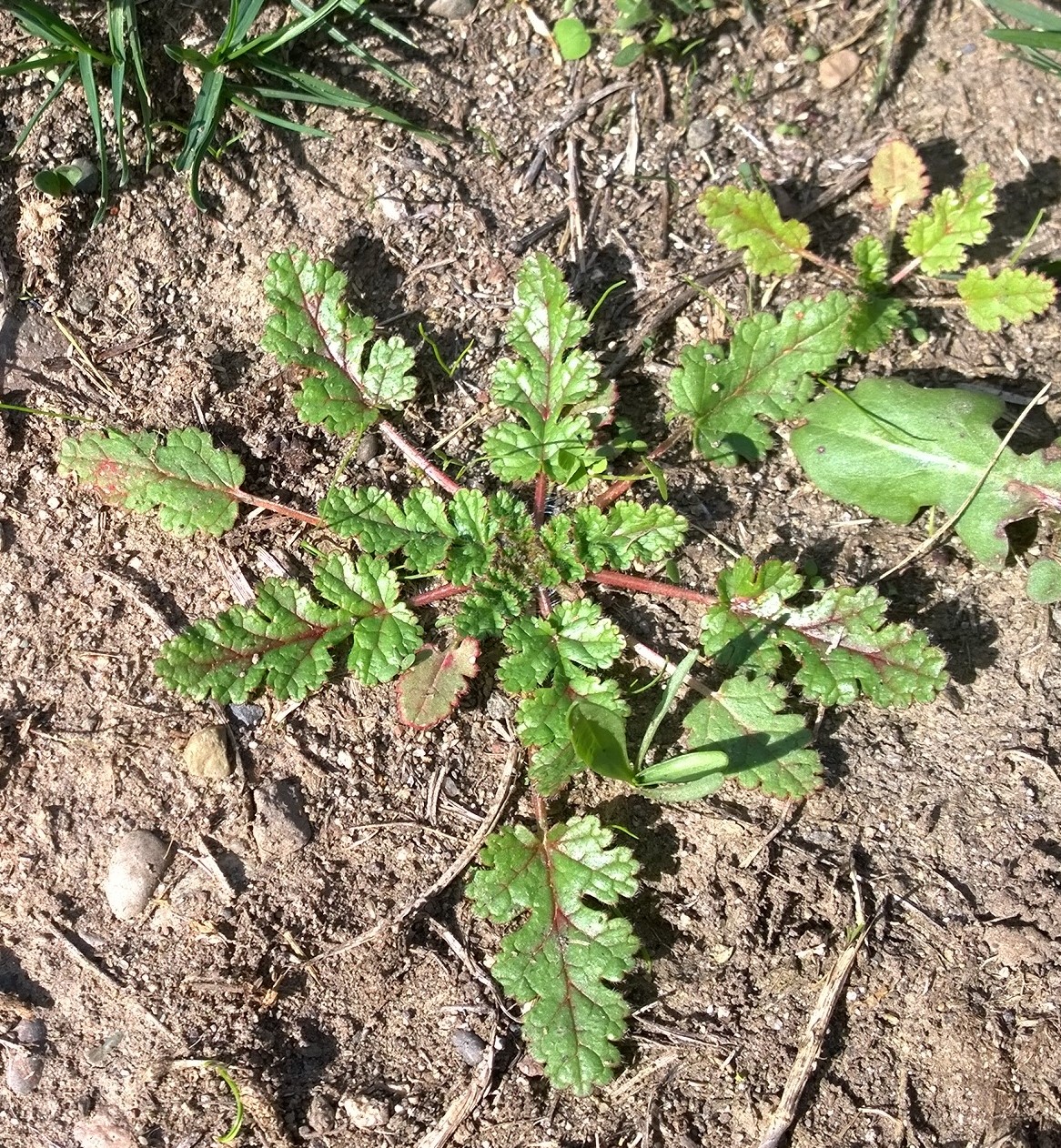
Heron’s bill (Erodium sp., AKA fillaree or storksbill) is blooming in fall.  It used to be one of the earliest flowers in the spring; this is new.  But many spring shrub flowers bloom again in fall in Grants Pass.  It started sprouting in midsummer in watered parts of the Reinhart Volunteer park, possibly because of cloudiness from Southwest monsoons getting this far north, and wildfire smoke shading, humidifying and cooling us for several weeks, after a long stretch of very hot weather in July.  Wood is made mostly from carbon dioxide and water, to which it returns when burned.

Large and coarsely divided
      red stem, coarse short leaf
finely divided, flat rosette

                                                                                                            young, fine, fluffy

            Its leaves are long and divided, growing in a rosette from fall through winter.  They can grow flat or fluffy, coarsely finely divided, with petioles that can be red, green, or shades between of pink or orange.  They hybridize readily.  As it blooms, it grows to about knee-high unless mowed.  If it is only mowed, it keeps making seed, like any annual weed, flowering and seeding under the mower blades.  Mowing thus does not control its spread.  Beating young plants into the dirt with a weed whacker can thin them out considerably.  Doing it again can finish the job.

Mowed heron's bill with fat petals.  Note the long, upright seed pods, center

             It has five-petaled 1/4 "-3/8" pink flowers whose petals vary from thin to fat.  They make seed pods 2-4 inches long that stick straight up as they grow and ripen.  The pods split into two seeds of about ¼ - 3/8 inches long with barbs on the seed and a long tail that spirals as it dries and pops the seeds off the plant.  The tail has a straight part at the end that sticks out at right angles to the seed and spiral.  When it gets wet, the spiral unwinds, and with the tail sticking to the ground, screws the seed into the ground at the other end—or into your pet’s fur, or eyes, nose, or ears.  It grows all over Grants Pass in neglected areas.

            I used to wait until heron’s bill bloomed to kill it, the blooms being the easiest way to find it, and not being certain that it would not come back if cut earlier.  But the flowers close by late morning; it makes seed fast; and it is harder to see after being mowed.  So I now kill it as I see it all winter, and it does not come back.  

            The easiest way to kill heron's bill is to pull it from soft soil.  In hard soil, I cut it under the crown, through the root, rather than trying to pull the taproot.  As an annual, it has no buds on its roots and dies if the crown is cut off, unlike dandelions and other perennials. 

            My favorite weed cutting tool has long been carbon-steel gardening scissors.  But this year, I have been cutting under weed crowns with a folding box cutter, that I keep in my back pocket.  I've also used a hula hoe, which get most of the crowns, and then go back and get the rest a few days or weeks later.  This year, I found hand hula hoes at Bimart that I can keep in my back pack and cleared most of a wet patch this fall.

Seedlings en masse

            As shocking as it might seem as a natural gardener, I am willing to use glyphosate to kill large expanses of weeds, as it is the most natural and safest of herbicides, being an amino acid, glycine, with a phosphate group attached.  It is only absorbed through green surfaces like stems and leaves.  Bacteria eat it in soil; it does not absorb into roots or bark.  Worms and pill bugs love it and multiply under its influence, as it is rich in nitrogen.  It is also a broadleaf and annual plant fertilizer, being also rich in phosphorus for making flowers and seed.  

            Worms and pill bugs attract moles, which make a mess.  Broadleaf fertilizer grows broadleaf weeds, but perennials like clover or creeping Jenny (Lysimachia) can be planted two weeks later and suck up that fertility, helping crowd out the weeds.  I think that the city at one point sprayed glyphosate all over the wild areas along the walking path from Greenwood to the pedestrian bridge in Reinhart Park and didn't plant anything to soak up that fertility, as all the plants along it are common annual and/or broadleaf weeds, mostly noxious.

Tiny heron's bill after glyphosate spraying in early spring.  

            Another problem arises if glyphosate is used on baby weeds when temperatures stay below 75 degrees F.  They can immediately make flowers and seed instead of dying.  The dwarfing effect can persist for two generations, leaving one having to manually kill a lot of tiny seeding weeds

            Without such influence, weeds tend to crowd each other out as bugs eat the losers in the struggle for light and nutrients, leaving many fewer, much larger weeds to flower, which is the easiest time to pull a plant.  When annual plants flower, the roots shrink as stems and flowers grow, and the stems become tough by the time they flower, which makes it easy to pull them.

Cranesbill, Mid-February

            There is a related plant, called cranesbill (Geranium sp.), with slightly smaller fringed pink petals and short seeds that don’t stick into your pets.  The leaves are round and divided, with long petioles.  It is not nearly as noxious as heron’s bill, though it is listed as a noxious weed in Oregon for its takeover habit.  Ironically, heron's bill is not.  It is easier to pull than heron’s bill, and not near as common in Grants Pass.

Edited 10/15/21 and republished online at GardenGrantsPass.blogspot.com  
Gardening is easy if you do it naturally.  Like Garden Grants Pass on Facebook. 
Join Ratepayers for Fair Water and Sewer Pricing on Facebook.
Rycke Brown, Natural Gardener          541-955-9040        rycke@gardener.com


Saturday, August 5, 2017

The Weekly Weeder: Whacking Weeds Can Work


          Whacking annual weeds can kill them, if you whack them low enough—right into the dirt, below the crown.  They have no means to grow without a crown, from which all their growth comes.  (Chickweed is an exception, as it does not have a crown and will keep trying to grow and set seed until it has made enough of it.)
          I saw weed whacking work several years ago, when the city or one of its maintenance contractors eliminated goat heads from the Wastewater Treatment Plant property for several years by repeatedly scalping the dirt where they grew with a string trimmer.  This year, they are blooming and seeding in their old locations near the back fence; apparently the maintenance contract has changed and the city’s institutional memory is short, but goat head seeds can sprout for at least 5 years and will come up all summer until frost.
          This year, I whacked the dense weeds along the irrigation ditch behind my mom’s house into the dirt in May, when they were still green and flowering, but hadn’t set seed yet.  A week later, I pulled a few that had been missed.  The next week, only the false dandelions had come back, and over two months later, that is still the case.
          Last week, I was pulling and cutting crab grass from the backyard below, and looking at the enormous quantity of spotted spurge growing along the same path, but not yet flowering, and asked myself why I didn’t just whack them all, as the annual weeds would be killed out, while the perennial grass and clover would come back from roots.  So I got my battery-powered trimmer out and started beating the dirt, working out which direction to work in order to throw the debris away from my legs and face.  The next week, that area was still quite barren.  This week, some were starting to grow back, and I whacked them again.
          I will have to repeat all summer and reseed clover in the fall, I am sure.  Spring weeds start in the fall and winter, flowering and setting seed around the same time in the spring, allowing one to kill them out for the season with one soil-scalping before they are ripe.  Some summer annuals, like star thistle, start together in spring and can be killed out as they start to bloom in early summer.  Most summer annuals keep sprouting through the hot weather, particularly where they are watered.  Goat heads have a final flush of sprouting as the weather cools in the fall, just as heron’s bill is starting its fall sprouting season.
What does not work to kill weeds, of any sort, is cutting two inches above the ground.  They continue to spread their flowers and ripen seed below the cutting height.  Weed control is seed control, and if the plants are still flowering, they are still violating our city code, which requires that one prevents flowering, seeding and noxious growth by cutting or killing.
                             

Rycke Brown, Natural Gardener          541-955-9040        rycke@gardener.com

Thursday, January 26, 2017

The Weekly Weeder: Prime time to kill spring weeds


          This year, I am concentrating on weeding out heron’s bill and other spring-blooming weeds through the winter, after spreading leaves in selected locations all fall to try to smother them out.  This year, most of them got started in the fall before falling leaves were even available, as we got early cool rain.  Even then, most of the bags of leaves could not be spread while gathering truckloads of them; I was gathering piles of bags for me and my customers while the getting was good and am still spreading them on one property.  A lot of weeds got smothered; some will get through.
          Today, I will be cutting heron’s bill out of Schroeder Park’s tent campground, where it is fairly easy to weed from the silty ground, there being little perennial grass for it to hide in there.  While I’m at it, I will be pulling groundsel, which is already putting out flowers and seed in many places.  Over the summer, the main target was goatheads, but I was cutting heron’s bill then, too, brought up by cooling irrigation water in late summer.
On February 4th, there is a “Weed Wrangle” in Griffin Park, starting at noon.  It is focused on pulling out Scotch broom, an invasive evergreen perennial shrub that is a great fire hazard.  It appears that they will be demonstrating the Uprooter, an amazing tool for pulling out shrubs.  But my focus will be on heron’s bill on the downriver side of the boat ramp, where I was cutting goat heads this summer.  There were young heron’s bill down there then, but I was concentrating on the goat heads, knowing that the heron’s bill could wait until now; it is not yet blooming.
Another target this time of year is bitter cress.  I used to wait until it and many other weeds flowered to pull them, because that is the easiest time to pull them, as the flowers show them up; their stems are strong; and the root is reduced and pulls right out in most cases.  But they are numerous; they all want to bloom close to the same time; and they tend to disappear into the greenery once their little white flowers are done blooming, until they ripen and start popping seeds, when they turn creamy yellow-white and show up bright and ugly, too late to stop the seeds from spreading. 
So I’ve learned it pays to pay attention to them and other weeds before they flower, and cut them as I see them, under the crown, from whence all growth of annual weeds comes.
                             

Rycke Brown, Natural Gardener          541-955-9040        rycke@gardener.com

Wednesday, October 12, 2016

Weekly Weeder: Start stopping spring weeds now

Groundsel has yellow, nodding flowers and bitter cress has tiny white, erect flowers.

          Fall has barely started, but spring weeds are already growing.  Now through spring is the best time to kill them.  Cheat, foxtail, heron’s bill, groundsel, bitter cress, cleavers and many others can most easily be killed in the months before they start blooming.  The earlier you get to them, the easier it is.

Heron's Bill, starting to bloom in the spring.  It takes a lot of mulch to smother it at this point.

          You can kill them three ways: by smothering with mulch, preferably leaves; by pulling them out; or by cutting them below the crown, the point from which roots and leaves grow.
          Smothering with mulch saves you the most work in the long run, in the places where you can mulch.  Leaves, when spread 2” or more deep, can stop weeds that haven’t even started yet and those too small or too crowded to be worth individual attention.  Tiny seedlings can grow through a few layers of light fluffy weeds, but more than that can make them run out of food before they find the light.  Blocking sunlight on soil can stop seeds that need sun on soil from sprouting at all.  And leaves make a lousy seed bed for seeds that fall on top of them because they dry out quickly.


Leaves covered with pine needles, which hold them in place.

          But not all leaves are created equal.  Some are eaten by worms before fall is even over, some by spring, some stick around until midsummer, and some have to lie around decomposing for a year before even crazy snake worms will touch them.  (If you have no soil life because fine bark has killed it all, it may take a year or more for even soft leaves to go away, but that’s a subject for another column.) 
Fallen red maple leaves stopping groundsel and other weeds 

          Hard leaves, like oak, sycamore, sweet gum and magnolia, tend to be stiff and fluffy and take a few more layers to stop weeds from growing through.  Many medium and soft leaves lie flat and can stop weeds from sprouting with only a single layer, but will be gone before summer weed seeds start flying.   A mix of hard and soft leaves 2 inches or more deep will stop most small seeds and plants from growing, and feed and soften the soil to easily pull the ones that get through.  2 inches of leaves in the fall is enough to keep flowers and shrubs fed and happy, with loose, easy-to-weed soil that is protected from rain and sun.
A foot or more of leaves will grow big vegetables as they decompose.  For small seeds, spread an inch of compost on top and plant on it.  Large seeds and starts can be planted into the leaves without compost, allowing the leaves to stop weeds from sprouting on top. 

Cheat, blooming en masse, at the point when the roots are shrinking and it is again fairly easy to pull.

Annual grasses, large and small, are most easily pulled from 3 to 6 inches tall.  The longer they grow, the more roots they hold the soil with and the harder they are to pull.  Annuals cheat and foxtail are a lighter green and have a softer texture than perennial grasses, are often fuzzy, and grow in clumps, without runner roots.  As they send up seed stalks in the spring, they use up their roots and are more easily pulled, but time is then short to pull them all.


Most taproots are more easily pulled when the ground is wet, but some in rocky or very hard soil, or with soft stems, won’t pull and must be cut under the crowns.  This will stop most annual weeds and many perennials, but some perennial taproots, like dandelion, dock, and creeping oxalis, need the soil to be loosened with a tool and pulled eventually.  Some, like oriental poppies, can grow back from a root tip deep in the soil and take several years to get rid of completely.
                             
Rycke Brown, Natural Gardener          541-955-9040        rycke@gardener.com