Tuesday, March 11, 2014

Stop crab grass before it starts

          Spring has sprung with a vengeance.  Foxtails are already putting up seeds stalks.  Sprouting crab grass cannot be far behind.  It’s time to mulch your lawn.

 Sprouting crab grass in bare soil.  The leaves are not only fat, but fuzzy.

          Last year, I started mulching crab grass in Dad’s lawn when it started sprouting, which was a bit late for the amount of mulch I was using, an inch of compost.  Sprouting crab grass is very small, and can be hard to see before it gets big enough to grow out of the mulch.  Not that the effort was wasted; the compost still stopped a lot of crab grass, and the lawn is looking much healthier and greener than last spring, without moss under the tree.

The fuzziness of young crab grass leaves shows better in this young plant.

          Even though it is early March, lawns are growing and being mowed.  Lawn grasses can readily grow through an inch of compost and will be much happier for it.  If your grass is perennial rye, a clumping grass, it’s a good time to seed it into the compost where it is patchy.  Dad’s lawn is mainly fine fescue, a rhizomatous grass, and white Dutch clover, both of which fill in when given sufficient organic matter, nutrients and neutral soil.  I also spread blood meal and ashes, bringing up the nitrogen, iron, and Ph to help kill the moss and feed the grass.

This young mature crab grass is growing in what looks like well-mowed Bermuda grass before its bloom.

          Crab grass is a clumping relative of Bermuda grass that also roots along its stems, but it’s tender, and dies with the first frost.  It is a tender perennial, as it does not die from making seed, but only spreads and makes more seed until it freezes.  It roots deeply where it is well watered, and hardly roots at all where it is not watered well, living on dust and dew collected on its hairy leaves. 
Bermuda grows rhizomes that can travel under sidewalks and go 18” deep and goes dormant about 6 months of the year in Oregon, making it a lawn weed, not good grass.   Bermuda and crab grass show their family relationship in the shape of their seed stalks, and the size of their seed, which is, thankfully, small and easily smothered with mulch.  So the same mulching that stops crab grass can also prevent Bermuda from germinating.
Ironically, in Arizona, where they use Bermuda as lawn grass, they mulch their lawns with steer manure every spring, which keeps them thick and green in the summer heat, and crab grass is rare.  Here in southern Oregon, I don’t recall seeing anyone else using steer manure or other compost on their lawns, and crab grass has spread all over town and down our country roads in the last 20 years.  Chemical fertilizers don’t smother weed seeds.
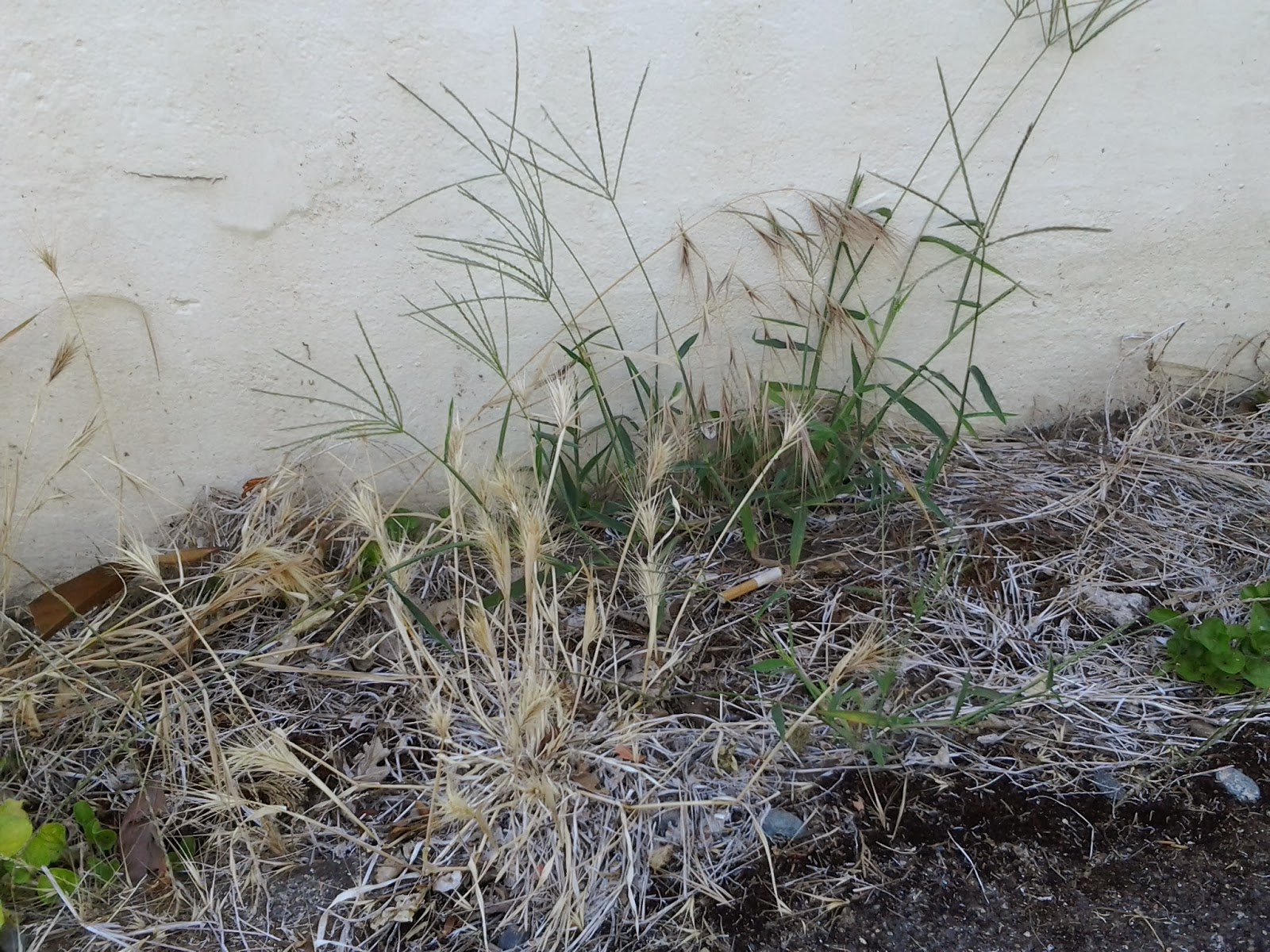

Green, mature crab grass with dry, seeded foxtails and cheat in dry ground.  Crab grass, being a perennial, is not a fire hazard like the other two as it stays green and growing until frost.

Even if you mulch, it is unlikely that you will stop all the crab grass in your lawn, since the seed is everywhere.  Unlike annual grasses, the roots of crab grass are tough and wiry, and where they go deep, it is nearly impossible to pull after it flowers.  But it can be cut off its roots with Kengyu garden scissors, and it won’t grow back, as it has no food in those wiry roots.
It doesn't pay to spray crab grass with Roundup (glyphosate salts).  It kills the plant, but fertilizes the seed in the soil; it comes back greener every time until you spray so much, so frequently that you over-fertilize.

Sunday, February 9, 2014

Let’s Clean Up Grants Pass


Our City’s top goal is “to be a city that looks safe and is safe.”  We have a real public safety problem in Josephine County and Grants Pass, our county seat.  As our official top goal implies, looking safe is the first step to being safe.
“Looking safe” means being clean, as clean and neat as we can, considering our county’s current lack of money to guard prisoners in the jail.  Even in the best of times with a fully funded jail, a clean city has less crime and general nuisance behavior than one that is full of litter and weeds.  Orderly surroundings invite orderly conduct; disorderly surroundings encourage disorderly conduct.  A lack of litter and weeds shows that someone cares what happens on a property; their presence shows neglect and invites trespass.
Littering is invited by the ugliness of weeds, as people try to hide their ugly in ugliness.  Ugly hedges also become repositories for trash.   Weeds make it harder to pick up litter entangled in them, particularly star thistles and blackberries.  The combination of litter and weeds calls in disorderly vagrant campers, many of whom mark potential campsites with litter to see if it gets picked up.  Old litter means that no one cares, and it is safe to camp.
This gardener recently started to take direct action against litter, the easiest thing to fix.  Litter only adds up; weeds multiply.  You can see me occasionally in my bright green advertising tunic, cleaning up litter from the most public and most littered places.  Private properties can and should be cleaned up by their residents and owners; public places like roadways and bridges get cleaned occasionally by governments, but they need a lot of help, and that is my niche.
This gardener, after all, is getting a bit old for doing the harder work of gardening, weeding, pruning and bed building, full time.  But litter cleaning takes little bending with the help of a litter grabber and rarely requires a wheelbarrow, except when one gets a wild hair and cleans up the tree litter and moss on something like the Caveman Bridge, which you can read about in The Litter Cleaner Blog at GPgardener.com
The work is satisfying and gets a lot of kudos, but it needs your help to continue over the long term.  I’m working for gardening customers three days a week and working for you, the public, for two.  If I get enough donations for public litter cleaning, I will not replace customers as they naturally drop out and will increase my litter cleaning, eventually to full time. 

Read The Litter Cleaner Blog and support litter cleanup in Grants Pass at GPgardener.com.
Rycke Brown, Natural Gardener        541-955-9040      rycke@gardener.com
Gardening is easy, if you do it naturally.

Sunday, January 26, 2014

Landscape Nuisances, Grants Pass Municipal Code, Title 5:

5.12.050 Weed, Grass, Snow and Ice Removal.
1. No owner or person in charge of property, improved or unimproved, abutting on a public sidewalk or right of way adjacent to a public sidewalk may permit:
A. Snow to remain on the sidewalk for a period longer than the first two hours of daylight after the snow has fallen.
B. Ice to cover or remain on the sidewalk, after the first two hours of daylight after the ice has formed. Such person shall remove ice accumulating on the sidewalk or cover the ice with sand, ashes, or other suitable material to assure safe travel. (Ord. 2901 §9, 1960)
C. Weeds or grass from growing or remaining on the sidewalk for a period longer than two weeks or consisting of a length greater than 6 inches.

2. Property owners and persons in charge of property, improved or unimproved, abutting on right of way adjacent to a public sidewalk shall be responsible for the maintenance of said right of way, including but not limited to: keeping it free from weeds; watering and caring for any plants and trees planted herein; maintaining any groundcover placed by the City; maintaining any groundcover as required by other sections of the Municipal Code or the Grants Pass Development Code. (Ord. 5380 § 18, 2006)

5.12.060 Weeds and Noxious Growth.
No owner or person in charge of property may permit weeds or other noxious vegetation to grow upon his property. It is the duty of an owner or person in charge of property to cut down or to destroy weeds or other noxious vegetation from becoming unsightly, or from becoming a fire hazard, or from maturing or going to seed. (Ord. 2901 §10, 1960)

5.12.070 Scattering Rubbish.

No person may throw, dump, or deposit upon public or private property, and no person may keep on private property, any injurious or offensive substance or any kind of rubbish, (including but not limited to garbage, trash, waste, refuse, and junk), appliances, motor vehicles or parts thereof, building materials, machinery, or any other substance which would mar the appearance, create a stench, or detract from the cleanliness or safety of such property, or would be likely to injure any animal, vehicle, or person traveling upon any public way. (Ord. 2901 §11, 1960; Ord. 4397 §1, 1981) (Ord. 5379 § 18, 2006)

Tuesday, January 21, 2014

Support Litter Cleanup in Grants Pass


The other day, I was walking my dog in the park and picking up litter, while wracking my brain for ways to make more money.  For the last 7 years, I have not been able to pay my bills by gardening, since my Social Security survivor’s benefits from my late husband ended.  My parents have been subsidizing me with loans, but that can’t go on forever. 
The amount of money I can make as a private gardener is limited by the number of people I can serve, which is less than a dozen, and by the amount that each can afford to pay.  I’m also 55, and the heavy work of gardening is starting to wear out my body. 
I suddenly realized that I was already serving the whole city by picking up litter, and I should get paid for that.  I had a vision of a bright green advertising tunic, telling people what I do and asking for donations.
I don’t pick up trash because I like to do so, any more than I garden because I like the hard work.  I do it because I have developed a passion for order and cleanliness through my work; I like the look.  Gardening is keeping order out of doors; picking up the litter is the first step.  It is relatively easy work that desperately needs to be done, every day, somewhere.
Wearing the tunic, I have a different attitude toward litter now.  Before, it just disgusted, especially when it was concentrated in one area, slowing me down.  Now it’s an opportunity to wear the tunic and possibly make money.  Plus, the mere act of picking it up while drawing attention to it with the tunic should get people to see litter and pick it up themselves.
But there is a tension in picking up litter for donations; one has to be seen doing the work, at least at first.  For now, I must stick to the main roads where I can be seen, when people are out to see me.  Once I start collecting enough donations from my website to pay my bills, I can work the alleys, side streets, parks and vagrant camping spots more.  Disorderly vagrants mark their territories with litter; picking it up discourages camping and other disorderly conduct.


If you want this work to continue and expand, please go to GPgardener.com and donate.  Right now, I’m working for customers 3 days a week and picking up litter for two.  If I get enough donations, I will not replace my customers as they drop out by attrition, and will expand the days I do litter cleaning.  If I don’t get enough money from this, I will have to find another job, and my customers and the city will lose the benefit of my private gardening and public litter cleaning.

Monday, January 20, 2014

Chickweed is great winter food and medicine

          A great eating green that holds up well through the winter is worth paying attention to.  One that also can be used to treat eye infections is even better.

Chickweed under the locust trees

Chickweed is already blooming and shedding seed down by the Rogue River along the bike/walking trail at the end of Greenwood Avenue.  It started growing this year months earlier than usual, sprouting with cold September rains, rather than waiting for November like recent years, or January as usual.  The early December snow and deep freeze, down to 8 degrees, didn’t damage the plants, perhaps because they were covered with snow, and they took off blooming and making seed before the end of the month.  It is probably more mature by the river than most places, temperatures being more moderate there.

 Chickweed closeup

I know it is seeding because I am making chickweed tea to treat conjunctivitis, AKA pink eye, and I end up with seeds in my cup.  It has boric acid in just the right amount to safely and effectively in kill bacteria in the eyes.  I make a small cup every day with a small handful of fresh, uncut chickweed and drop some in my eyes morning and night. 

 Fresh, whole chickweed ready for tea

 Making tea and sterilizing the medicine jar

Prepared medicine and leftovers

It must be made fresh daily to work, as it can get cloudy quickly.  To keep it fresh for the day, I sterilize the jar I keep the dropper in with boiling water at the same time I make the tea; pour some tea in the sterilized jar with the dropper; and lid the jar until the tea is cooled enough to use. 
It stings a bit at first, but stops the itch immediately and clears up the eyes.  Like other antibiotics, it must be used for a week or so after symptoms subside to stop them from returning.  I put about ¼ cup of tea in the jar, eat the mouthful of wilted greens, and drink the rest for a tonic high in vitamins A, C, iron and calcium.
The easiest way to pick chickweed is to grab the top of its mass of leaves and cut off the top 2-3 inches with a knife.  They are crawling, succulent plants that can stand about 6 inches high in a mass, and the tips are the best eating.
          They are great as a wilted green with dinner, or fresh in sandwiches and salads, much like spinach with smaller leaves and succulent stems; a little bitter, but a good bitter.  I like a sandwich on Dave’s Killer Bread with peanut or almond butter on one piece and cream cheese on the other, with jelly and chopped chickweed between.
            The locust trees by the river, and the box elder and plum in my backyard, make perfect chickweed habitat, as their leaves fall early; they are soft and eaten quickly by the soil; and they make rich soil under dappled shade, with winter sun through the branches.  The variety that grows by the river has larger leaves than most, and was easily spread to my backyard by pulling the seedy plants in late spring and spreading them where I wanted them to grow.


Gardening is easy, if you do it naturally.

Thursday, December 19, 2013

Make Room to Use Your Leaves


This yard was originally fine bark mulched; it is now covered with blue star creeper, white thyme; and sweet woodruff; the brown is fresh locust leaves from the tree above.  They cover it through the winter. 

        Properties from tiny yards to large parks have trees for shade and beauty.  They produce leaves that mostly drop in the fall, and flowers, fruit and seeds that drop any time of year, depending on the plant.  These properties also may have lawns, shrub borders, paths, pavements, or even unplanted waste areas.
          Leaves and other tree debris must be removed from lawns, lest they kill the grass, though some can be mulched into the lawn without harming it, with the grass clippings.  They have to be removed from buildings, lest they rot roofs and clog gutters.  They have to be removed from pavements, lest they be a slipping danger, and as a matter of order and cleanliness.  They should be removed from paths, so they don’t rot the mulch, fill the gravel, or get tracked indoors.
          That leaves must be removed from some places does not make them trash.  They are not waste unless they are wasted by being hauled to the composter, because one is wasting their unique ability to stop weeds and feed soil naturally.  Burning them further wastes their potential use as compost mulch that can be used to stop weeds and feed soil, while polluting the air with the acrid scent of burning mulch.  But even hauling them to the composter costs money.

 Even a thin accidental mulch of soft maple leaves stopped a lot of groundsel from sprouting on the edge of this weedy field.

          Leaves have a truly unique ability to stop weeds because the top few layers dry quickly, making a poor place for seeds to germinate.  All other mulches are seed beds by comparison, not drying as fast on top and providing holes and cracks that seeds can settle into and sprout.  


 Fresh wood chips at Dimmick; the county started using them in 2012 on many parking lots.

The second best weed-stopping mulch is wood chips, which also layer and dry out on the surface, though not as quickly.  They are good mulch for paths; they even clean your shoes, and look nice and bright, freshly spread in mid-winter.  They also stay in place better than leaves, and can be used on steep, narrow parking lot dividers and berms.
Leaves should, therefore, be used on beds, shrub borders and unplanted areas to control weeds, which saves the work of laboriously raking and picking leaves out of the shrubbery.  They can be spread anywhere from 2 to 6 inches thick to control weeds and feed the soil, softening it for easy weeding of whatever manages to come up through the leaves.  A foot of leaves will grow huge vegetables while they decompose.
Fine bark, less than a year old, with the leaves "cleaned" out of it.  Note the black bark and soil.

 Many people like the “clean” look of finely ground or shredded bark, but it cannot stay clean for long, with leaves, flowers, fruit, and twigs constantly falling from trees and shrubs.  Few workers have the patience to clean them all out anyways.  In either case, scattered bits of organic debris do not look clean or pretty.  

 Plum leaves blend right into 3/4" nugget bark.
The more coarse the mulch, the more it hides the stuff that falls into it.  Nugget bark and walk-on fir work for this.  Leaves are not only the most coarse mulch, hiding all but the largest debris, but they do a much better job as mulch than anything else at mulch’s three jobs:  stopping weeds; holding water; and feeding soil.
Fine bark mulch has to be renewed regularly as it decomposes, turns black, and evaporates, which takes money to buy bark and labor to spread it.  Leaves renew themselves every fall and during the year as trees add stuff to the mulch, nearly all of which is welcome.  They just need to be moved from places that they don’t belong to the soil where they do, which is a lot less work and expense than cleaning them up and replacing them with bark.
 Lawns are good places for people and dogs to play and to have smooth, green open space to look upon.  They are high maintenance, but their care seems relatively uncomplicated compared to beds full of shrubs and flowers, since most of it can be done with machines, like mowers and blowers, which reduce stoop work.  They also need to be weeded, but using a mulching mower can prevent small-seeded weeds, like crabgrass, dandelion, and annual rye, from sprouting.
Still, if you have a lot of lawn, but not enough places to put your leaves, you have too much lawn and are doing too much work.  When beds and borders are maintained with leaf mulch, they are less work to maintain than lawn by a long shot: no mowing, and little weeding.  If they are generously large enough for the normal growth of the shrubs therein, little pruning is needed. 
Shrub borders are often built way too small.  Two to three feet wide around a building is common, requiring tight hedging, which is high maintenance and not as beautiful as the natural shape of the plant.  If it is, one might reconsider one’s choice of shrub for that spot.  
Hedges have their place for providing privacy and wind shelter in tight spaces.  Sometimes, they provide it to the wrong people; they are security problem.  But many shrubs are hedged simply because they outgrew their space.  Limb them up or cut them to the ground and either let them re-grow naturally or replace them with something that will fit the space better as it grows, and you will save a lot of work and have beautiful shrubs, instead of ugly hedges.  Limbing up is preferable for trees.
 A line-of-motion path, with nugget bark and japanese maple leaf mulch, and a Hinoki cypress starting to get in the way.

Same path the next summer, with the cypress limbed up and the path improved with 4 x 8 sand.

The natural line of motion for people and dogs to go around a building is a smooth curve.  The edge of the bed should come out to that natural walking line, if space allows.  Any lawn occupying that natural bed space can be mulched heavily with leaves and the grass weeded out as it comes through.  A border of good-size rocks can contain the leaves and provide a solid edge for a look of permanence.

Lawn with a curved border, and line of motion bed, partially mulched with leaves. 

Lawns can be shrunk to places most easily mowed.  Steeper slopes and sharp angles can be mulched with 6 inches of leaves and planted to ground covers, shrubs, and perennials. 
Make room for your leaves in your landscape by shrinking lawns and expanding borders, and you will do less mowing, need less weeding and pruning, and not be wasting work, taking leaves out of where they do the most good and are hardest to remove.  You don’t need to get rid of leaves, just rearrange them to where they will do their natural job of stopping weeds and feeding soil.

Rycke Brown, Natural Gardener        541-955-9040      rycke@gardener.com
Gardening is easy, if you do it naturally.

Tuesday, December 3, 2013

Using Leaves Efficiently For Mulch


Leaves are the cheapest and most effective mulch for weed control, when enough of them are used.  This natural gardener has been using them professionally on clients’ yards for 13 years.  All other mulches are seed beds by comparison.  Leaves feed the soil and thus the plants; soften it for easy weeding; and can stop sprouting of most small seeds, just by keeping the sun off them.  As long as leaves stick around, they stop germination of seeds that land on top of them, because the top few layers dry out quickly and don’t allow seeds on top to sprout.
One can smother nearly any annual weed, and many small perennials, with enough leaves.  But to be efficient with a client’s money, a professional gardener must figure out the least that it takes to do the job effectively when one has to bring them in from other places.
There is no need to shred leaves to use them for mulch in most situations.  Whole leaves are better for blocking weeds, but leaves can be mowed into a lawn, and shredded leaves will stay in place better where the wind would otherwise blow them around.
Only very large trees drop enough leaves beneath them to stop larger annual grass seeds like cheat and foxtails, but taking them from pavements, roofs, lawns, paths, and neighbors with too many and spreading them more thickly in beds and borders can smother grass seeds and young weeds while encouraging larger established perennials.
There are three basic classes of leaves as mulch: soft leaves; tough broad leaves; and tough conifers.  Black walnut is a soft leaf in a class of its own, containing a pre-emergent herbicide, juglone, that stops smaller seeds all summer, though their leaves are eaten before winter is over. 

Red maple leaves, blown onto a weed field from fine bark.  Not thick, but still smothering groundsel seeds.

Although soft leaves may be eaten by soil life before summer is over, and sometimes before fall or winter is over, they can have great smothering ability until they are eaten.  Many tend to lie flat over seedy soil and stop spring weeds like groundsel and bitter cress, even without extra leaves piled on.  Piling them 6 inches or more deep will preserve the top layers of leaves over the entire season, as they quickly dry out on top while the worms happily eat the damp bottom leaves.  But that’s a lot of leaves unless one wants to grow vegetables.  In that case, a foot is even better. 

Oak leaf mulch under a large oak

          Hard leaves, like oak and sweet gum, stick around the entire season, but tend to be stiff and fluffy, and thus allow seeds to grow through them to the light.  Again, it usually takes more than naturally falls under the tree to stop many weeds, particularly annual grasses with larger seeds.  Merely covering the ground is insufficient, especially with weeds already growing.

Pine needles naturally fallen beneath the tree.  

Pine and true cedar needles are good for covering other leaves to hold them in place and give a consistent, quiet look to one’s mulch.  They are also good for covering compost spread on top of soil or leaves to aid seed germination, when spread just thick enough to hide the compost seed bed.  Piled over an inch deep, they stop germination as well as other leaves, as they pack down fairly tight.  They can be used for path cover, but pine are rather slick and not suitable for slopes.  Flat or non-needle conifer leaves, like fir, incense cedar, redwood, and sequoia, are soft and decompose as fast as other soft leaves.

 Pine needles spread as mulch. They are much used in the South, going by HGTV.

          Six inches to a foot of leaves can grow big food plants.  But piling one kind of leaf too deep can occasionally result in slow decomposition and slow growth of plants.  A mixture of several kinds of leaves has more variety for the soil life to eat, more nutrition, and allows water to move down through the stack more efficiently.  It is important to spread them in layers and keep the surface relatively flat, so the water doesn’t just run off the top or around bundles of leaves.
          One can grow garden seeds in a thick bed of leaves if one spreads an inch of compost on top of the leaves and plants into and on it.  This even works on top of black walnut leaves and soil, keeping the seeds separated from the juglone long enough to sprout.  Compost also helps decompose leaves more quickly for early spring growth.  But it is not necessary for planting large seeds, like beans, corn, and squash, into the leaves.  Poke them in to where you can feel moisture for them to sprout in.
          But for non-food-growing areas, a mulch of leaves with several thin layers, each just thick enough to hide what is beneath, can provide maximum weed control with minimal leaves.  Use soft leaves on the bottom to smother and physically block seeds and small plants from growing.  Hard broad leaves can be spread on top of those to keep the sun off the soil all summer.  Pine needles go on top to keep the leaves in place and give a consistent, calming look to the landscape. 
Leaves work well for mulching beds and borders, but weeds in paths have to be controlled, too.  Just about any material one puts on a path will sooner or later become a seedbed for whatever lands on it, except for pavement, and even there, they will grow in the cracks and holes.  Organic path mulches must be renewed every year or so.  Gravel is a headache once it fills with seeds and dirt.

4 x 8 sand, surrounding beds.
 
But a half-inch of 4 x 8 sand, which is river sand screened ¼-1/8 inch, can let you defeat the weeds by bringing them up right away, so you can slide a scuffle hoe, AKA hula hoe, underneath their crowns and pull or cut them off their roots.  Rake out the weeds, and your path is cleared without bending.
The key to how 4 x 8 sand works is that, when particles of different sizes are disturbed, the smaller sift to the bottom and the larger end up on top.  Dirt and small seeds on the path are sent by hoeing and raking to the bottom, and rocks and sticks larger than the sand float to the top where they can be raked out or picked up and thrown in the bed.  Quarter-inch rocks dominate the top, and don’t stick to shoes.  When seeds sprout, their crowns form at the top of the sand, so they are easily cut off their roots.  Very young plants whose crowns are cut off their roots are killed, as they have no food in their roots.

Gardening is easy, if you do it naturally.