Monday, May 19, 2014

Use Water Wisely

A Pound O Rain sprinkler in use.

         Proper watering has become a matter of controversy, as many people think that watering is optional and wasteful of water that someone somewhere else can use.  You cannot waste water in Grants Pass by irrigating properly, which means all over the ground and plants.  The water either evaporates from plants and soil, is sucked up by plants and transpires, or sinks into the water table and recharges wells and the river.  That which goes into the air humidifies the air, cools it, and contributes to rain.  The only real way to share it with people in other places is to use it and send it downwind to make rain.

Some think that if they don’t water, they won’t have to mow.  But weeds don’t care about watering, even thrive on dryness, and once they have taken over a lawn, one must mow more often to keep their flowers from seeding the neighborhood and making the yard uglier yet. 

Some say to use plastic mulch and drip irrigation.  Plastic mulch is ugly.  Drip is unreliable and incomplete.  You can’t really tell how well drip is working if it is covered, and it’s delicate.  You can have a leak and not know it; voles chew holes in it; shovels break it; tree roots and rocks pinch it.   You lose the benefit of evaporation from wet plants and soil and don’t wash the dust off your plants, causing fungus on leaves.  People think that it is bad to water paths, but trees, shrubs, and even large annuals like tomatoes send their roots under paths and suffer when they are not watered.  And it’s not cheap or easy to build a drip system. 

The best watering is also cheapest and easiest: sprinklers.  Automatic sprinklers are the most expensive system to build, though most reliable.  But poor people can get by best with hoses, sprinklers, and mechanical faucet timers.   Watering by hand sprayer rarely works well; one must hold a hose too long.

The best sprinklers are also cheap: Pound of Rain, a pound of metal with a big hole in the middle, which blows out a nice, even circle of water and can pass BBs.

Water an inch per week for good growth and beauty of lawns, vegetables, most ornamentals and fruits, and it’s best to water any one spot only once a week, twice at most.  One can move a sprinkler or two around a yard to hit everything once a week.  For even watering, one must set the sprinkler on the edge of the previous wet spot, as no sprinkler sprays completely even.  Automatic sprinklers are set up to water to the next sprinkler to cover an area completely; even watering is double watering, so you only need ½ inch at a time on each spot.

Last, but not least, do not skip watering because it is going to rain.  When it rains half an inch or more, skip watering for a few days.   It may sound superstitious, but if you don’t water, it won’t rain enough to matter.  Call it insurance.

Please Don’t Save Water

The rain that put out last summers fires.  It fell much more heavily in the Douglas Complex area.

          Grants Pass is beautiful this spring.  The new growth on our trees and shrubbery is bright and abundant, thanks to last summer’s forest fires.  While miserable for people and animals, the smoke from those fires was full of CO2 and water vapor, plus ash, which was watered in by the fall rains that came early and put out the fires.  Indeed, the water vapor produced by the burning of all that wood must have contributed to the rainstorm that put them out, probably quite heavily.
          We have just had a warning of the summer heat to come, which will blast all those nice, tender new leaves unless we give our plants the water they need to keep them green. 
We didn’t have much snow in the mountains this winter, so the snowpack that our rivers and irrigators rely on is low.  On the other hand, spring rains have filled the reservoirs.  We are being told that we have to save water to make it last through the summer. 
One has to ask what we are supposed to be saving it for.  If we don’t use it, it will only run to the sea.  If we use it to water our yards and feed the water cycle, we can make rain that will continue to fill our creeks, rivers, and reservoirs, and help make it last all summer by re-circulating it upstream.  We are dependent on rain this summer, so we’d better do our best to make it rain.
We on the West Coast are blessed to take our water from rivers that run west into the prevailing wind.  Any water that evaporates or transpires blows upstream and uphill and can make rain in the top of our watershed.  It can even make rain right on our heads, if we get thunderheads.
Thunderheads we will have, no doubt about it.  But watering our cities and farms makes the difference between wet thunderstorms and dry lightning that makes forest fires.  We make rain when we water enough.  In the two last decades, we haven’t been watering enough.
A computer simulation by University of California researchers showed, last January, that farmers in California make rain in the desert Southwest. This inspired a study of summer rainfall in the Grants Pass 97526 zip code from 1983-2012 that showed that we had larger rainstorms in July and August than in June and September through the first decade, and the reverse in the last two decades.  Over those last two decades, our average monthly summer rainfall, June-September, fell by nearly a tenth of an inch per decade.
In the 80’s, we had reasonable water rates, and nearly everyone watered, mowed, and took care of their yards; this was a very neat town, reminiscent of Goshen, Indiana.  It seemed like we had thunderstorms nearly every week in the summer.  Now we have tiered rates that charge us through the nose for watering our yards, and dry, dusty, sometimes smoky summers.
If Grants Pass based our water charges on what it costs to provide the service, the rate tiers would be reversed, with most of the charge on our basic winter water use.  The vast majority of the cost of clean, delivered water is overhead in plant and employees, which must be covered regardless of use.  Talk to the city about changing its water rate structure, and water like the quality of your life depends on it, regardless of the rates.  It does.

Sunday, April 27, 2014

How to Grow Great Tomatoes, peppers, melons, corn, and other heat-loving annuals

 4" tomato planted among gabion rocks, in compost covered with pine needles
          
          If you want to grow a tomato plant that makes a lot of great fruit, start with a plant that isn’t blooming yet, not even showing a sign of buds.  Buds are a sure sign that the plant is getting root bound and is trying to make seed before it dies.  The plant has switched from vegetative growth to blooming and won’t grow much after you plant it.  If the buds are still very small, you can pinch them and it might switch back.  If it is blooming, don’t buy it or plant it.
          It can be hard to find plants that are not blooming in the markets.  Gallon plants always have flowers, and fruits abound.  Even 4-inch pots are often budding or blooming.   Your best bet is to buy 4- or 6-paks, and check them carefully for buds.  Don’t despise seed.  I’ve seen many a volunteer out-produce starts.
          Tomatoes need warm soil, good soil, and regular water.  Don’t plant them before the soil warms up a bit.  Trying to beat the last frost is a losing game, because the plants won’t grow until the soil is warm, and pests will eat them.   A good sign that it is time to plant is sprouting of volunteer tomatoes or other warmth lovers where they were grown the year before.
          Spend some time preparing the ground first.  If your soil is poor and grows small weeds, cover it with about 6 inches of compost and enough pine needles or coarse bark to cover, or a foot of mixed leaves from the fall.  If it grows big, leafy weeds, two inches of compost may be sufficient to smother most weeds seeds and small plants.  Pull whatever comes through the mulch.

The corn and tomatoes in the center were planted in a foot of leaves, no compost on top.  The foreground bed to the left was planted too thick with peppers and tomatoes, but with gabion rock on top.

Plant your starts into the compost or leaves if they are thick enough.  If not thick enough, pull the mulch aside and dig in the soil a bit, and then pull the compost and top mulch back around the roots.  Do not plant it deeper than it was in the pot; that will just make it easier for pill bugs to eat the leaves.  A plant that is not root bound doesn’t need to grow roots from its stem.
Last, but not at all least, surround the plant with rocks, to soak up heat during the day and release it at night.  Night warmth is critical to growth.  A few big flat rocks are good; even better is a solid 2 to 3-foot circle of cheap river rock, called gabion rock at Copeland.  Covering a bed with them produces the best results, but removing them each year for mulching can be a chore. 
4" Peppers planted among gabion rock and Dog Creek glacier till

All of the above goes for peppers, with emphasis on warmth at planting time and starting small.  They are even more likely to be blooming in 4-inch pots; look for 6-paks.
Squash, melons, cucumbers, corn and beans are all better off bought as seed and planted when the soil is warm.  They hate any sort of root disturbance; seeds will beat anything started in a pot.  Melons and cukes benefit from warming rocks; squash, corn and beans don’t need them.  If your seeds don’t grow, the soil was too cold; replant.
         
 Support litter cleanup in Grants Pass at GPgardener.com.  Like us on Facebook.

Saturday, April 5, 2014

The litter business is picking up

This gardener has gotten a bit old for the stoop work of gardening and is really tired of the litter in parts of this town and so has been moving on to cleaning litter from areas of public access and asking for donations and sponsors to continue and expand this much-needed work.  Starting litter pickup two days a week in early December, I made a bright green advertising tunic; started a website, GPgardener.com; got a payment vendor; made a better tunic; started The Litter Cleaner Blog to document my work; made a sign for my truck; and recently started getting sponsors, including one Super Sponsor. 
Carl Wilson of KAJO/KLDR has pulled me away from Redwood Avenue and is paying me to clean his portion of the Miracle Mile, as he calls the Rogue River Hwy.  Logan Design has donated small and large bright green stickers for advertising.  The City of Grants Pass sponsors me with bright yellow litter bags, which they allow me to drop in our parks next to trash cans for easy pickup by their crew. 
You or your business can Super Sponsor weekly litter cleanup of a particular landmark, like the Caveman Bridge, the area beneath it, a stretch of road, or an alley, for $500 a year, less than $10 a week.  It need not be in a single payment; $250 is enough to get started cleaning.  Recognition on the GP Gardener Super Sponsor page, which includes your logo and business motto, must wait until you’ve paid $500 within a year.  Some areas may take more than one Super Sponsor to cover, but one is enough to get the work started.
It takes only $100 of donations in a year to be listed as a Sponsor, for which you can sponsor cleanup of either one day of an event (before, during and after) or weekly cleanup of your frontage if you are near a sponsored site and it is not too large.   Donations of any amount are greatly appreciated and any amount donated by website or mail will get you at least a thank-you note and a small and large sticker.  You will know that you are supporting cleaning of Super Sponsor sites ($10 a week doesn’t go far) or any other place I feel the need to clean. 
Donations for my litter-cleaning business are not tax deductible as a charitable donation, and will be reported as income for tax purposes.  Business sponsorships can be reported as advertising expense, since one is listed on the website and I tell people who is sponsoring a place as I clean it.
I can only cover so much ground, so I will be able to offer Super Sponsorships of new areas only until my work week is filled, so it pays to buy in early.
Please visit GPgardener.com, read The Litter Cleaner Blog and donate today.  You can also like GP Gardener on Facebook.

Read The Litter Cleaner Blog and support litter cleanup in Grants Pass at GPgardener.com.
Rycke Brown, Natural Gardener        541-955-9040      rycke@gardener.com

Gardening is easy, if you do it naturally.

Wednesday, March 19, 2014

Foxtails are already blooming

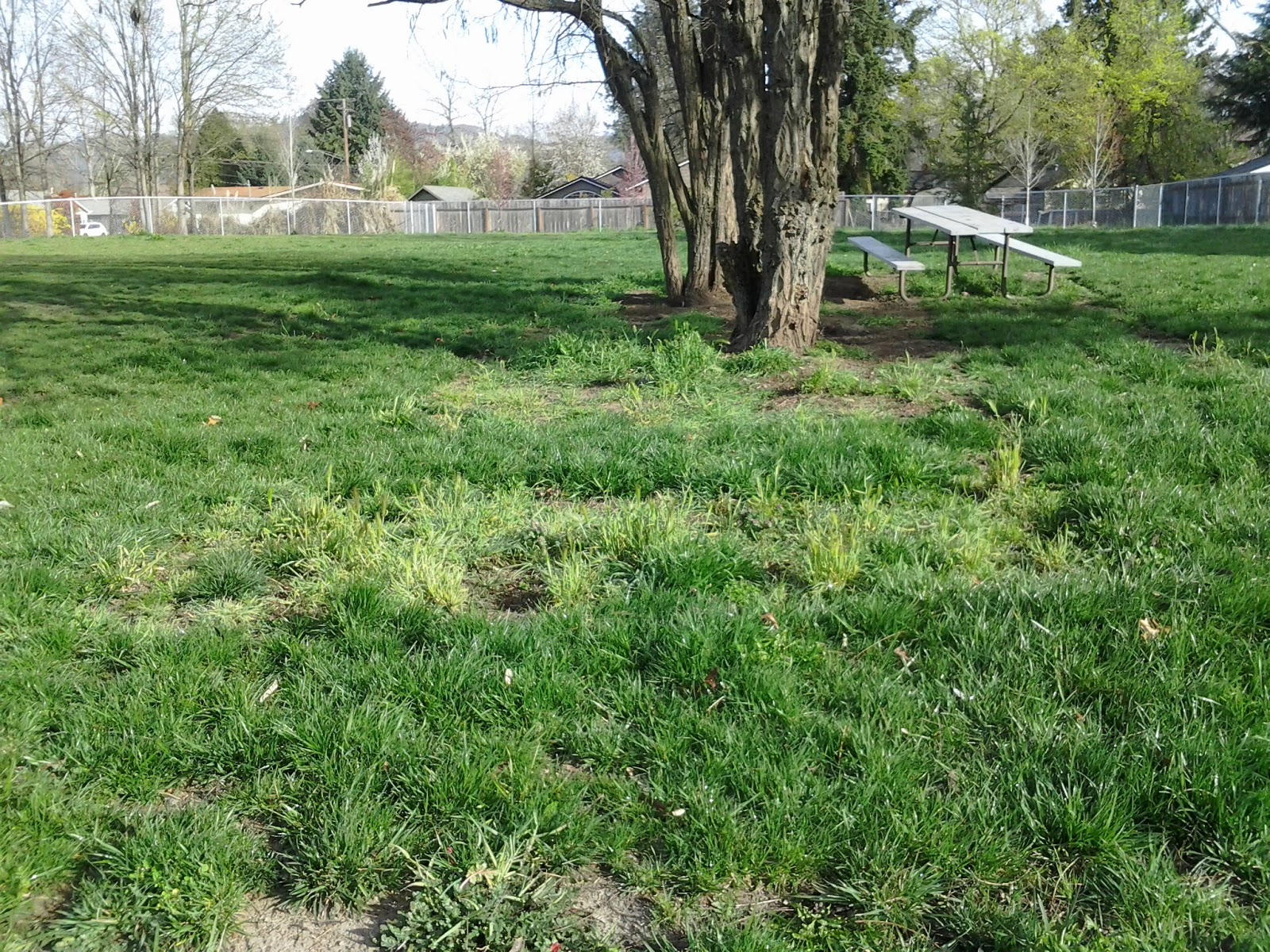
       Blooming foxtails in Greenwood Dog Park, suffering from a fungus that yellows its leaves

        This morning I stopped with my dog at Greenwood Dog Park to throw some balls, and noticed that foxtails were already putting up seed stalks under the locust trees, shocking in early March.  It’s more normal to see them starting to bloom in April.  I pulled a plant with a seed stalk; it pulled easily.  It’s officially weeding time at the dog park, though I expected to go after heron’s bill there before foxtails. 
Heron’s bill is just starting to bloom.  It’s normally among the earliest of annual weed flowers, but bitter cress is in full bloom and groundsel is already going to seed along the trail.  It’s going to be a heck of a weeding season, with the warm weather bringing out some weed flowers early, while others that are daylight-dependent bloom on their regular schedule.

Light colored foxtails show up well against dark green lawn grass

Blooming is the signal for weeding because that is the easiest time to kill any annual plant.  It is also the express trigger for enforcement of our weed nuisance code, which forbids allowing weeds to “mature or go to seed.”  Maturity is blooming; seeding is the next step. 
Stop the plant when it blooms, and it cannot spread seed to your neighbors, becoming a nuisance first simply by spreading.  Weeds are also ugly when gone to seed; “seedy” is a synonym for neglected.  The seeds of heron’s bill, foxtails, and cheat grass stick in clothing and fur and can downright dangerous to pets; heron’s bill drills itself in when the dry seed gets wet, and all three are barbed.  Last, but not at all least, tall, bushy annual weeds dry out and can burn.
Annual plants are easiest to kill when blooming because they put all their energy and much of the mass of their roots into top growth to produce stalks, flowers and seed, while their roots shrink and loosen in the soil. The stalks are tough and have a good hold on the crown, where all the new growth comes from.  The roots pull easily from moist soil compared to earlier in the season, when the roots are large and the top is soft. 

Seeded foxtails in Bermuda grass, showing why it pays to pull it green.

But you don’t have to pull the roots of blooming annual weeds, as there is no food in the roots.  The crown, where the growth comes from, is the key.  Cut them under the crown with scissors, and they are gone, even big tap-rooted annuals like thistles.
Preventing weeds is better than weeding.  It takes work, but it isn’t stoop work, the hardest kind of work to do.  You can mulch bare soil with leaves, compost, wood chips, or coarse bark to stop smaller seeds from sprouting and growing.  An inch of compost just before crab grass sprouts can stop crab grass and feed good grass in a lawn.   It’s time; it’s been warm and grass is growing.
For rough areas, leaves are cheapest, most effective, and encourage perennial grasses, which are good for holding ground and not becoming a huge fire hazard.  I used to dislike perennial grass, but it’s much better than annual grasses like foxtails and cheat.

Tuesday, March 11, 2014

Stop crab grass before it starts

          Spring has sprung with a vengeance.  Foxtails are already putting up seeds stalks.  Sprouting crab grass cannot be far behind.  It’s time to mulch your lawn.

 Sprouting crab grass in bare soil.  The leaves are not only fat, but fuzzy.

          Last year, I started mulching crab grass in Dad’s lawn when it started sprouting, which was a bit late for the amount of mulch I was using, an inch of compost.  Sprouting crab grass is very small, and can be hard to see before it gets big enough to grow out of the mulch.  Not that the effort was wasted; the compost still stopped a lot of crab grass, and the lawn is looking much healthier and greener than last spring, without moss under the tree.

The fuzziness of young crab grass leaves shows better in this young plant.

          Even though it is early March, lawns are growing and being mowed.  Lawn grasses can readily grow through an inch of compost and will be much happier for it.  If your grass is perennial rye, a clumping grass, it’s a good time to seed it into the compost where it is patchy.  Dad’s lawn is mainly fine fescue, a rhizomatous grass, and white Dutch clover, both of which fill in when given sufficient organic matter, nutrients and neutral soil.  I also spread blood meal and ashes, bringing up the nitrogen, iron, and Ph to help kill the moss and feed the grass.

This young mature crab grass is growing in what looks like well-mowed Bermuda grass before its bloom.

          Crab grass is a clumping relative of Bermuda grass that also roots along its stems, but it’s tender, and dies with the first frost.  It is a tender perennial, as it does not die from making seed, but only spreads and makes more seed until it freezes.  It roots deeply where it is well watered, and hardly roots at all where it is not watered well, living on dust and dew collected on its hairy leaves. 
Bermuda grows rhizomes that can travel under sidewalks and go 18” deep and goes dormant about 6 months of the year in Oregon, making it a lawn weed, not good grass.   Bermuda and crab grass show their family relationship in the shape of their seed stalks, and the size of their seed, which is, thankfully, small and easily smothered with mulch.  So the same mulching that stops crab grass can also prevent Bermuda from germinating.
Ironically, in Arizona, where they use Bermuda as lawn grass, they mulch their lawns with steer manure every spring, which keeps them thick and green in the summer heat, and crab grass is rare.  Here in southern Oregon, I don’t recall seeing anyone else using steer manure or other compost on their lawns, and crab grass has spread all over town and down our country roads in the last 20 years.  Chemical fertilizers don’t smother weed seeds.


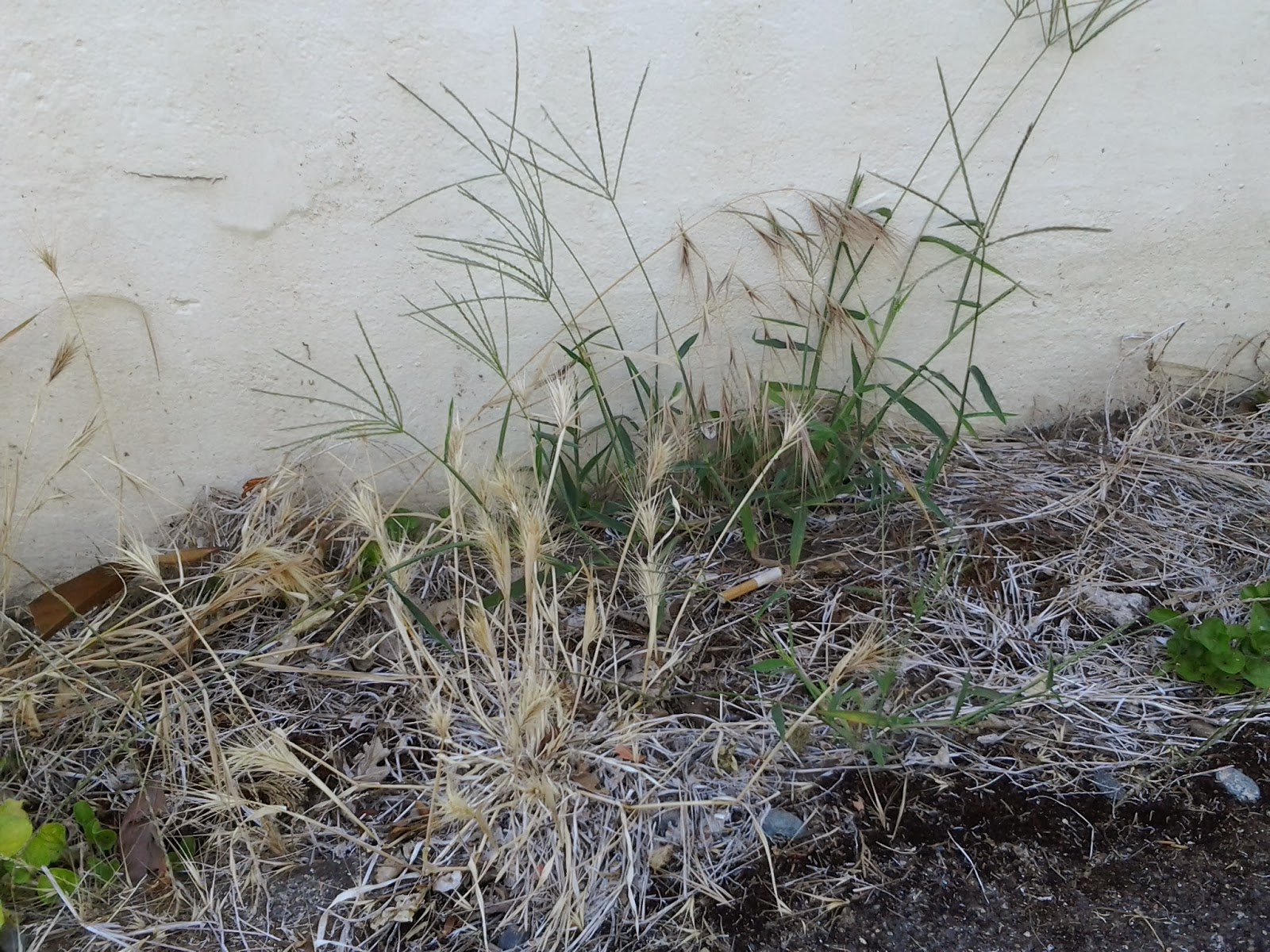
Green, mature crab grass with dry, seeded foxtails and cheat in dry ground.  Crab grass, being a perennial, is not a fire hazard like the other two as it stays green and growing until frost.

Even if you mulch, it is unlikely that you will stop all the crab grass in your lawn, since the seed is everywhere.  Unlike annual grasses, the roots of crab grass are tough and wiry, and where they go deep, it is nearly impossible to pull after it flowers.  But it can be cut off its roots with Kengyu garden scissors, and it won’t grow back, as it has no food in those wiry roots.
It doesn't pay to spray crab grass with Roundup (glyphosate salts).  It kills the plant, but fertilizes the seed in the soil; it comes back greener every time until you spray so much, so frequently that you over-fertilize.

Sunday, February 9, 2014

Let’s Clean Up Grants Pass


Our City’s top goal is “to be a city that looks safe and is safe.”  We have a real public safety problem in Josephine County and Grants Pass, our county seat.  As our official top goal implies, looking safe is the first step to being safe.
“Looking safe” means being clean, as clean and neat as we can, considering our county’s current lack of money to guard prisoners in the jail.  Even in the best of times with a fully funded jail, a clean city has less crime and general nuisance behavior than one that is full of litter and weeds.  Orderly surroundings invite orderly conduct; disorderly surroundings encourage disorderly conduct.  A lack of litter and weeds shows that someone cares what happens on a property; their presence shows neglect and invites trespass.
Littering is invited by the ugliness of weeds, as people try to hide their ugly in ugliness.  Ugly hedges also become repositories for trash.   Weeds make it harder to pick up litter entangled in them, particularly star thistles and blackberries.  The combination of litter and weeds calls in disorderly vagrant campers, many of whom mark potential campsites with litter to see if it gets picked up.  Old litter means that no one cares, and it is safe to camp.
This gardener recently started to take direct action against litter, the easiest thing to fix.  Litter only adds up; weeds multiply.  You can see me occasionally in my bright green advertising tunic, cleaning up litter from the most public and most littered places.  Private properties can and should be cleaned up by their residents and owners; public places like roadways and bridges get cleaned occasionally by governments, but they need a lot of help, and that is my niche.
This gardener, after all, is getting a bit old for doing the harder work of gardening, weeding, pruning and bed building, full time.  But litter cleaning takes little bending with the help of a litter grabber and rarely requires a wheelbarrow, except when one gets a wild hair and cleans up the tree litter and moss on something like the Caveman Bridge, which you can read about in The Litter Cleaner Blog at GPgardener.com
The work is satisfying and gets a lot of kudos, but it needs your help to continue over the long term.  I’m working for gardening customers three days a week and working for you, the public, for two.  If I get enough donations for public litter cleaning, I will not replace customers as they naturally drop out and will increase my litter cleaning, eventually to full time. 

Read The Litter Cleaner Blog and support litter cleanup in Grants Pass at GPgardener.com.
Rycke Brown, Natural Gardener        541-955-9040      rycke@gardener.com
Gardening is easy, if you do it naturally.